Improvisation and spiritual connection

I studied classical trumpet as a youth. While I loved my horn and its sound, learning to play musical compositions perfectly eventually became a terror for me. The problem with performing classical music for me, is that everyone knows what the music is supposed to sound like, and if you make a mistake, everyone knows, and they can do a “gotcha” afterwards. It is extremely unpleasant and I know I developed a defense of pointing out my mistakes before anyone else could. It’s not a good way to enjoy performing.

I quit playing trumpet for about fifteen years, and I only got back into it through circumstance (including back injury from a car accident and a chiropractor who was also a trumpet player) and because I was then involved with groups that were pretty much entirely improvisational. When you improvise, I felt, there are no wrong notes. I could believe this enough that I was able to play comfortably for audiences.

I was brought up on perfectionism, and it has caused me great pain in my life. I am only able to play as long as I believe that right and wrong don’t apply. The key, for me, is to have fun, and now I live to teach others to improvise and to have fun — to listen for what they love in music, instead of listening to criticize or feeling that they have no right to make music because they aren’t good enough.

Composition is the process of inventing and writing down music. Improvisation is making up music in the moment. Unless someone listens to a recording of an improvisation and transcribes it into music notation, it is never written down.

The process of writing is quite different from the process of improvising. It’s the same as the difference between writing a story or telling a story during a conversation. When you write, you usually revise and revise many times over. When telling a story, you tell it once for the audience, and then it is gone. Whatever you bring to the performance is never going to be seen or heard again, even if you record the event, or transcribe the improvisation.

Each performance of a composition is unique, just as each performance of a play is unique or each reading of a story is unique, yet there will be a marked similarity in the performances, since they are trying to enact the composition as accurately as possible.

In improvisation, anything might happen. An improvisation can sound “wrong” but if you make a “mistake” you merely have to repeat it to make it sound like something you meant to do, and if you repeat it, then it becomes an acceptable part of the experience. There are no wrong notes. Wrong doesn’t make sense in improvisation.

Composition is not completely about setting music in stone, but, except for matters of interpretation, musicians are expected to play compositions note for note, without any room for improvisation. While jazz compositions do have room for improvisation, you are still expected to play the heads in a way that will be recognizable. You’re allowed to put it to a different rhythm or time signature, and even to modulate it, but these are variations, that must leave the melody recognizable. Even in the improvisational parts, you have to stay within the structure of the composition, because playing too far outside that composition can rattle your bandmates, unless they are prepared for free improvisation.

Free improvisation can start from anywhere with anything, and can become anything it wants. People often wonder how music develops in free improvisation, if there is nothing composed at all. This is possible because music is essentially about repetition, and you barely need to repeat a few notes, for others to pick up on what you are doing and help you build it. Free improvisation is about listening for the recognizable motifs, supporting them and building them into larger patterns. If you play with musicians who listen well and are generous in supporting each other, this is easy.

It’s also easy with people who don’t consider themselves musicians. Set a few ground rules, and people can learn to improvise quite happily with each other very quickly. See Improvisation Games for more about the Sonic Sandbox improvisational instruction process.

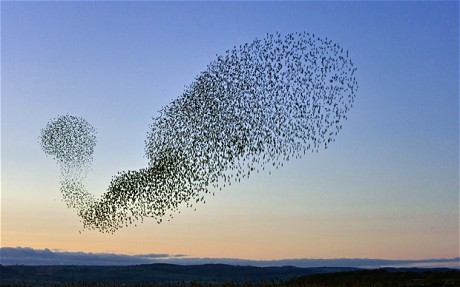
Improvising music is built into human beings, I believe. It is a part of our natural pattern recognizing abilities. We do it instinctively, the same way that birds can flock together in amazing formations with millions of birds, and they never hit each other in the air. We know much more about rhythm and melody and harmony than we are aware of. We have been unconsciously analyzing these patterns all our lives, and so if we are allowed to play together without judgment, we can do it easily and intuitively.

It is only judgment that turns musical improvisation into musical composition. Someone writes down music, and makes critical choices about how they want their music to be performed from here on. Others make judgments about how well performers interpret that composition.

After writing this, I now believe it is fair to say that improvisation is about working with what we know, intuitively. Composition is about taking intuition and making judgments about it. For me, that takes a lot of fun out of music making. Music making is for fun and play and for bringing people together in a way that connects us without using our linguistic minds. Some people call this spiritual. I don’t care what people call it, so long as we can share that experience and feel more connected.

My practice is to find something to love in the sounds people make together. This helps me suspend judgment, and reach an altered state of consciousness that is not possible when my critical mind is engaged. This altered state helps me accept myself and others, and perhaps most importantly, it helps me feel connected in a way that I crave most of the time.
West Philly Porchfest

Thirty years ago, give or take a month, I arrived in West Philly to look for a place to rent. I looked at a place on Windsor avenue, across the street from where I live, now. I had just graduated with a degree in Labor Relations, and I was moving to Philly because my girlfriend was going to Grad school at Penn. I was looking for work with a union.

One of the things that I thought would help in locating a good place to live was to interview people living on the street about what it was like. The person I interviewed is now my next door neighbor, and her husband was working for a union. What more did I need to know about the block?

That decision changed my life forever (not that every decision you make doesn’t change your life in the same way). It led to me finding a cool place to dance, which led to meeting my wife, which led to more dancing, which led to music returning to my life when a car accident made it impossible to dance. Which led to…. And led to…. And so on.

When we moved into this house after we married, 48th Street was the edge of the gentrified area. Now, I have no idea how far it extends, but it’s a lot further out. 50th? 52nd? When we moved in, it was a pretty quiet area that focused on each block, in terms of most community activities.

In those days, the neighborhood was not only seen as edgy, but also not very cool. It might still be edgy in a different kind of way, but now, as my daughter said on returning from college last week, “The neighborhood is a lot cooler now than it was when I left.”

This was even before Porchfest. How cool are we now?

The band that eventually became Sonic Sandbox started a little over a year ago, when I started jamming with a few friends. When we started, the others weren’t sure what they wanted to do, but I had an idea about how we could improvise together, which is what I wanted to do because playing music that other people know makes me feel judged, and feeling judged makes me not want to play.

I don’t want to be compared to anyone, because I’m convinced I won’t compare well, and I’ve used that feeling to hurt myself a lot in the past. Instead, I wanted to get together to improvise because when you improvise, nobody can tell you that you didn’t do it the way it was supposed to be.

I had a few musical games in mind that we could use to start us improvising, and we started using them to jam together. We tried doing other people’s songs once or twice, but we kept going back to the improvisation, especially as the others came to understand the process better.

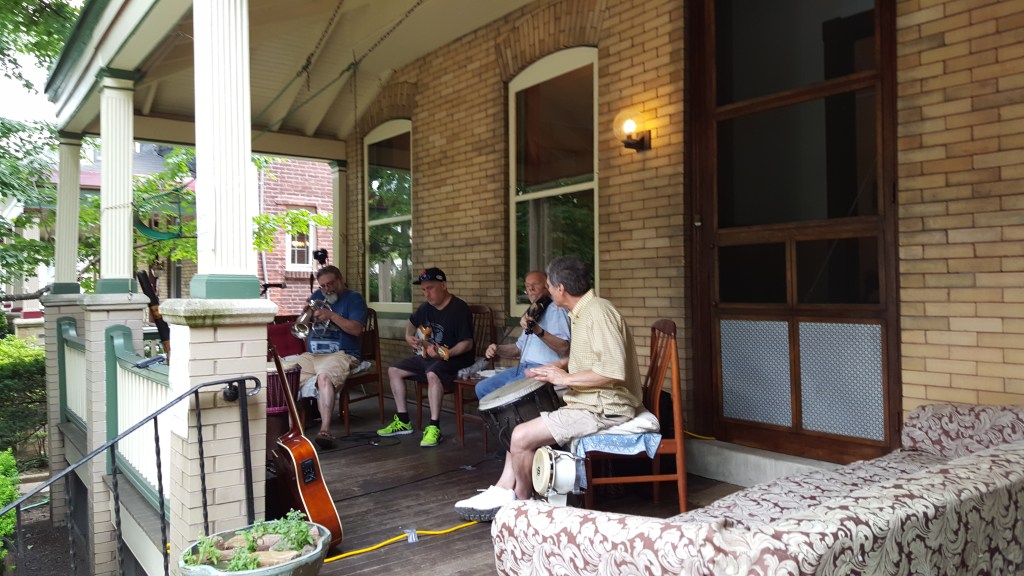
Playing at Porchfest was perfect for us, because they just wanted people to make music. They didn’t care about your experience. No one was getting paid. We were all on our own to make things go. But is was a community thing. Strength in numbers. The intangible feeling of support you get knowing that everyone knows this is happening and a lot of other people are out there playing or listening. It’s such a West Philly thing for me.

One of the things I like to do sometimes when we improvise, is to sing a story that I make up as I go along. I just picture some events from my life in my head, and do a musical play by play as the internal movie plays in my imagination. I sang the story that I am now writing.

In the end, I started talking about what I find so cool about West Philly. Porchfest is a perfect example of that kind of thing. It’s all about people not judging each other. It’s about setting up community, connecting to others and not judging. Not criticizing. There’s an awful lot of creativity in this community, and that’s no accident. Creative people locate here because it’s a safe place to play, to express ourselves and to live the way we want to without others judging us. I’m not saying there are no limits, but the limits are a lot more flexible here than in many other communities. West Philly is an oasis for many people who get stigmatized and judged for being who they are in a lot of other places.

I told myself that playing on our porch was just like any other time we get together to jam. We’re just playing, and we’re doing it so we can get out of our minds and into that place where we become part of something larger than ourselves. It doesn’t matter if others like it or don’t. We’re doing it for fun.

Of course, having support does make a difference. So when an audience started filling the chairs I had put out, it gave us a lift. It’s nice to be able to play for others as well as ourselves, and we knew people were there by choice. They could get up and leave any time they wanted, but they could also stay, and stay they did.

I think we were all grateful for the people who listened to us having fun playing together. They were fellow players in the sonic sandbox, and some of them even joined us. We take inspiration from any place we can, and once we started like a pack of dogs, because my neighbor’s dog was barking. Listen hear:  It may have started in an unusual way, but what it turned into had a lot of energy, and that’s true for most of what we do.

I think it helps to understand our process when you listen to us. It’s not just about pretty sounds. It’s about accepting sounds. When we accept the sounds we hear, no matter how we might judge them if we were in judgement mode, we can take them to places we’d never go otherwise. That means we have to ask an audience to give us a chance. Don’t give up in the first couple of minutes. It might take us a while, but we will find some place cool, musically speaking, to go. It’s just that we have to wander around in trackless spaces for a while before we can agree on what path to follow. I have fond hopes that people will enjoy listening to us wander, and then be amazed at the incredible scenery we find when we agree on a trail to follow.

Whether or not people listen to us that way, we can still have fun wandering around together and creating a path through the places we’re exploring. We can do that, and we can lead others in doing that through our workshops, and others can watch and listen to us doing that in our performances. What’s important is that we do it. It’s a spiritual practice for us, and as long as we do it, we’re better off, and if we can share it with others, either as participants or as audience, there’s a chance that others will be better off, too. That’s my hope.